
SQUAT · Simulated testing and research panels for solo builders, small teams, and product leaders
Start with what you know.
Test and research with SQUAT.
Finish with the confidence to act.
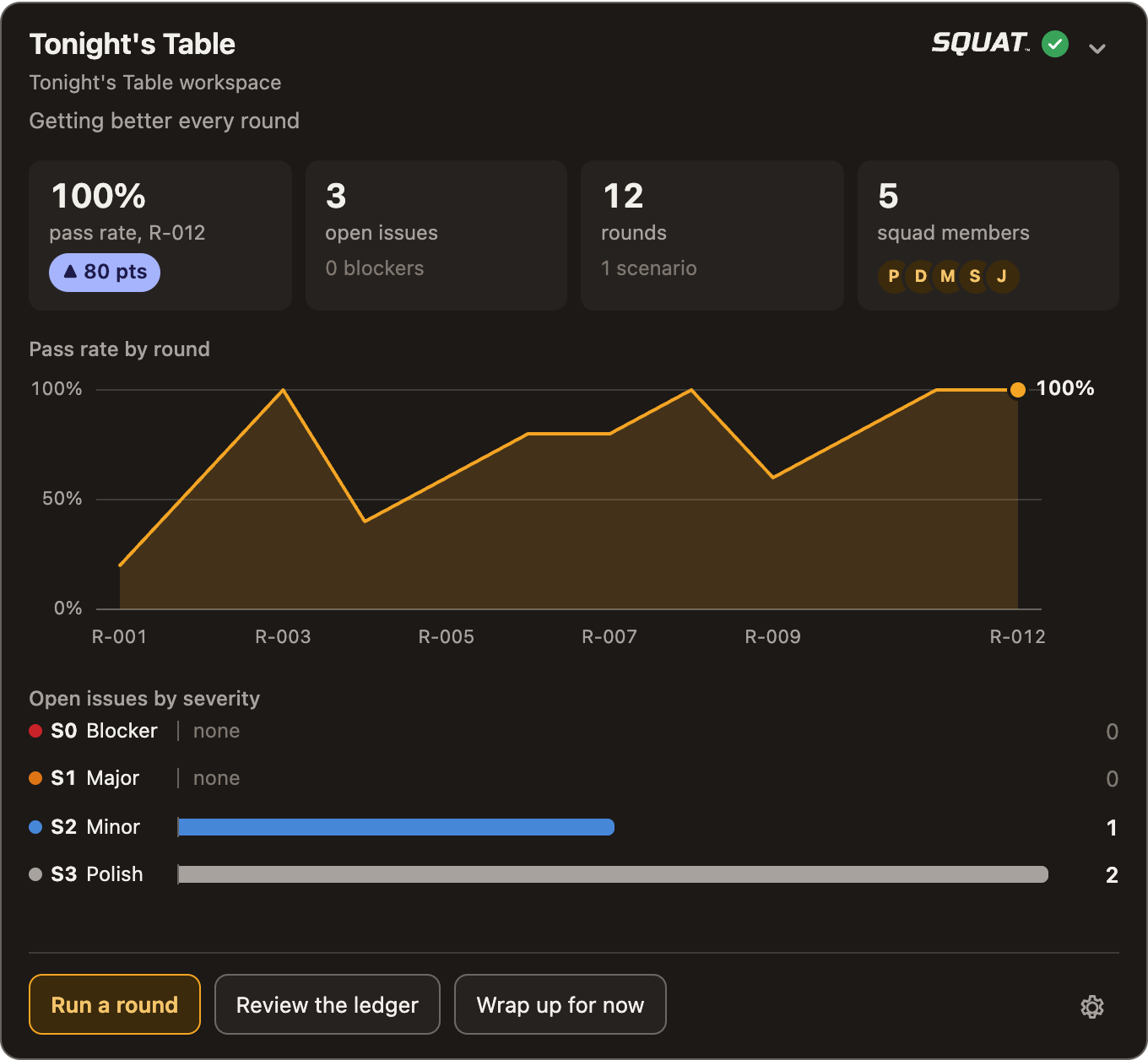 Create panels of simulated personas for user-acceptance testing and qualitative research — delivered within the AI you use today, including ChatGPT and Claude.
Assemble your squad, give it a goal — not scripts or code — and watch what it uncovers: the shortcut never planned, the dead end you didn't know about, the exact step where they give up. Every round lands in a ledger, so every cycle, you know what changed and why.
SQUAT makes research and testing possible without asking you to surrender your expertise, judgement, or your pocketbook.
US only for now. Join the waitlist and we'll let you know when we launch.
Discover what works (and what doesn't)
You can whip up a new design and working concept of a product in an afternoon now, but a prototype still leaves important questions. Can someone find their way through it? Where might they get stuck? Which idea deserves more investment?
Whether you build alone, lead an agency, or bring recommendations to leadership, SQUAT helps you explore more angles, with written reports for you to rely on and share.
HOW TO SQUAT
Bring what you know
Simply start a conversation with SQUAT in your AI client, like ChatGPT or Claude about your audience, product, and the decisions ahead. Bring existing interviews, research, or profiles when you have them. SQUAT helps you build your squad and frame the study.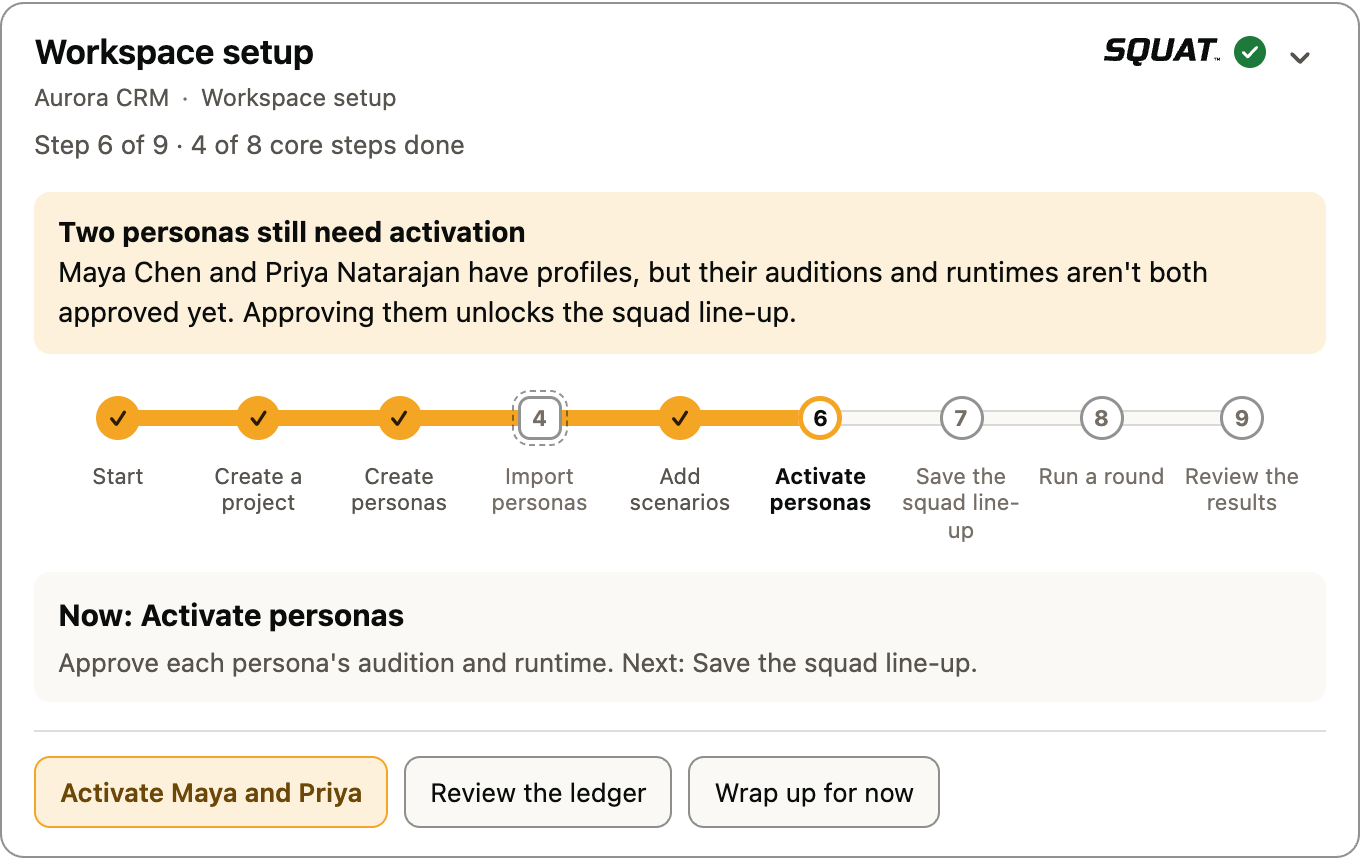
Run your tests and research panels
Run scored UAT to investigate a product experience, or a qualitative panel to explore concepts and reactions. A guided method keeps the work focused on your question.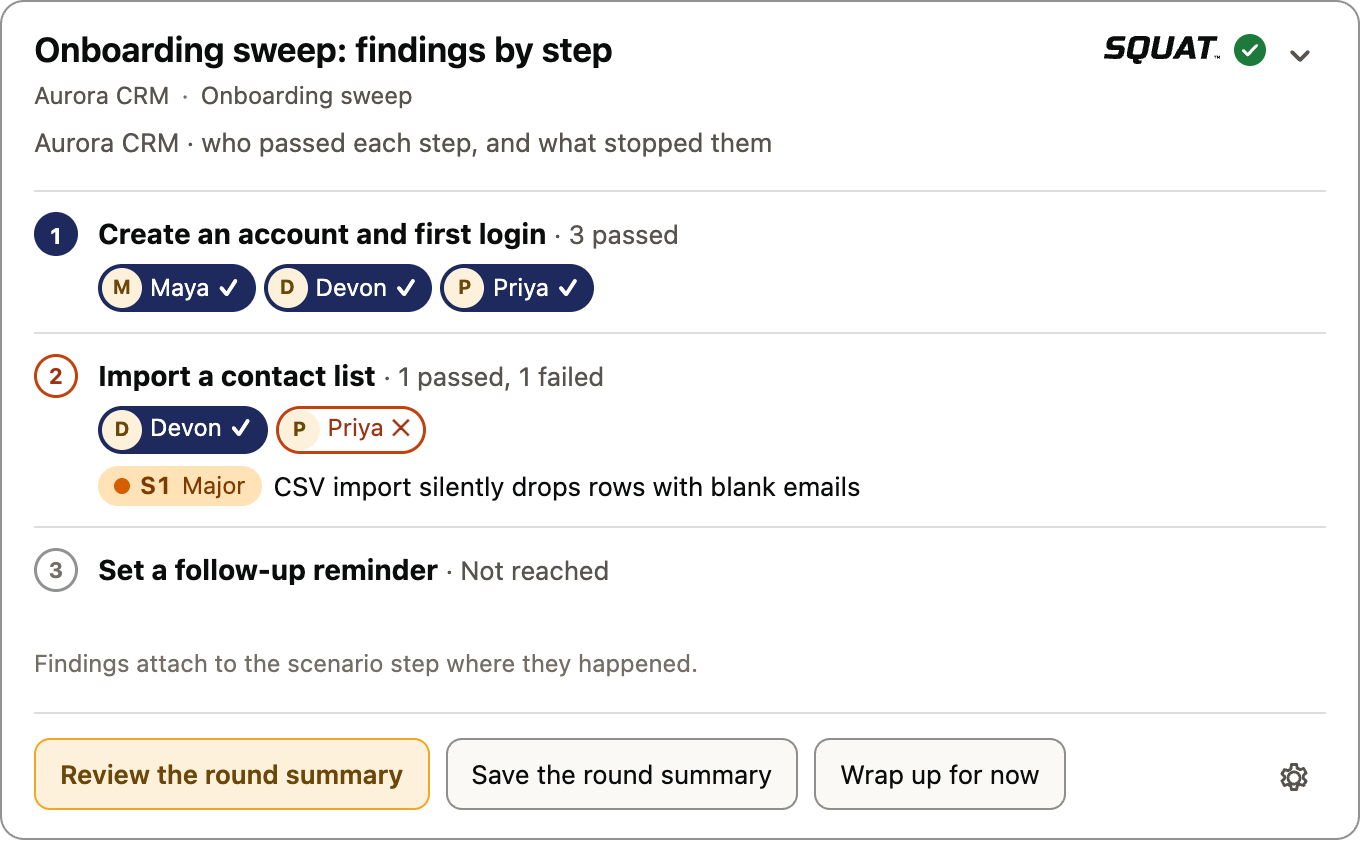
Inspect the evidence and report
Review the findings, trace them to the recorded dialogue and artifacts, and decide what deserves action or further investigation. Keep the record for your next round.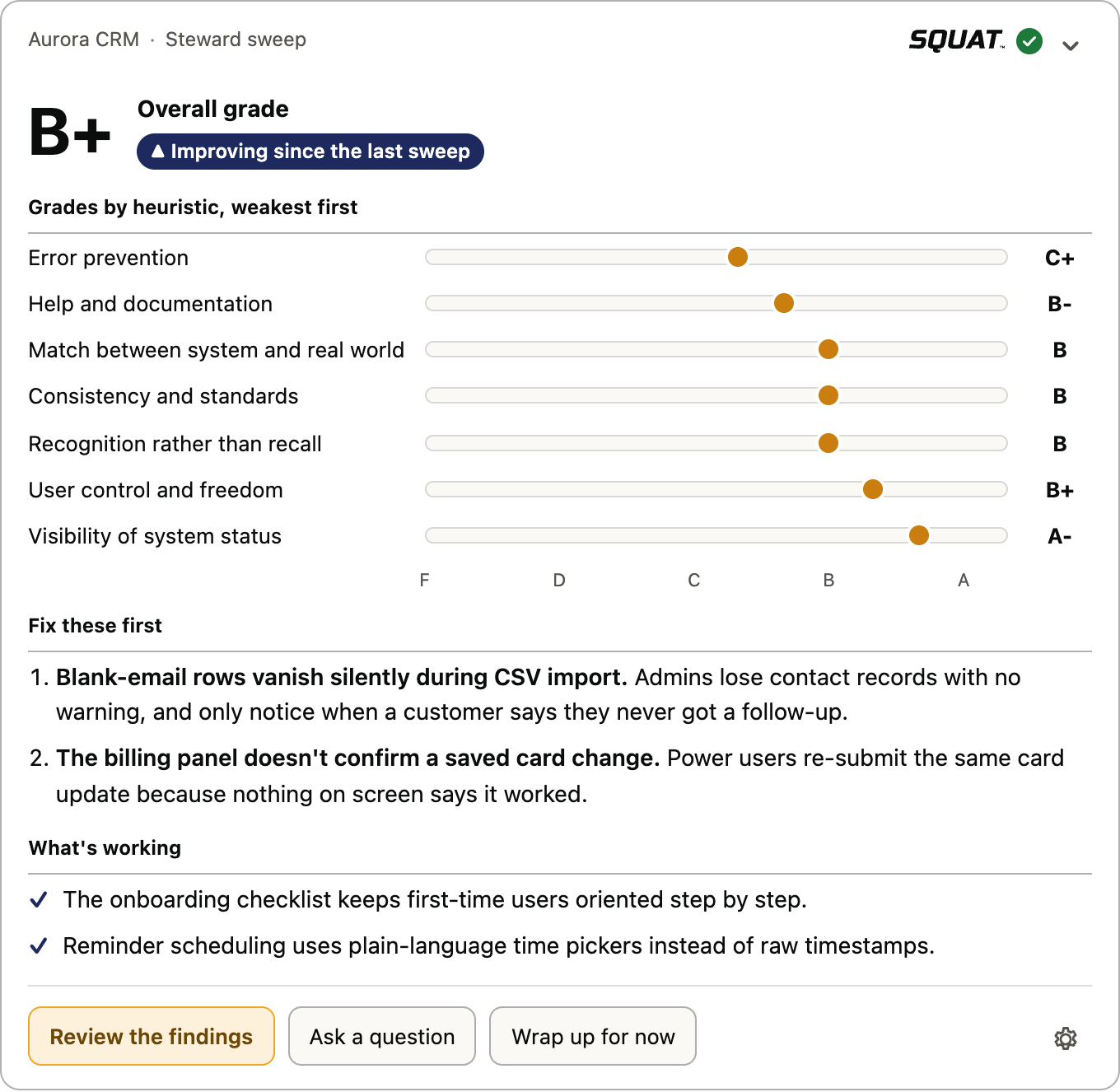
The Research Round
Guided by method. Grounded in evidence. Pointed at the questions you decide are worth asking.
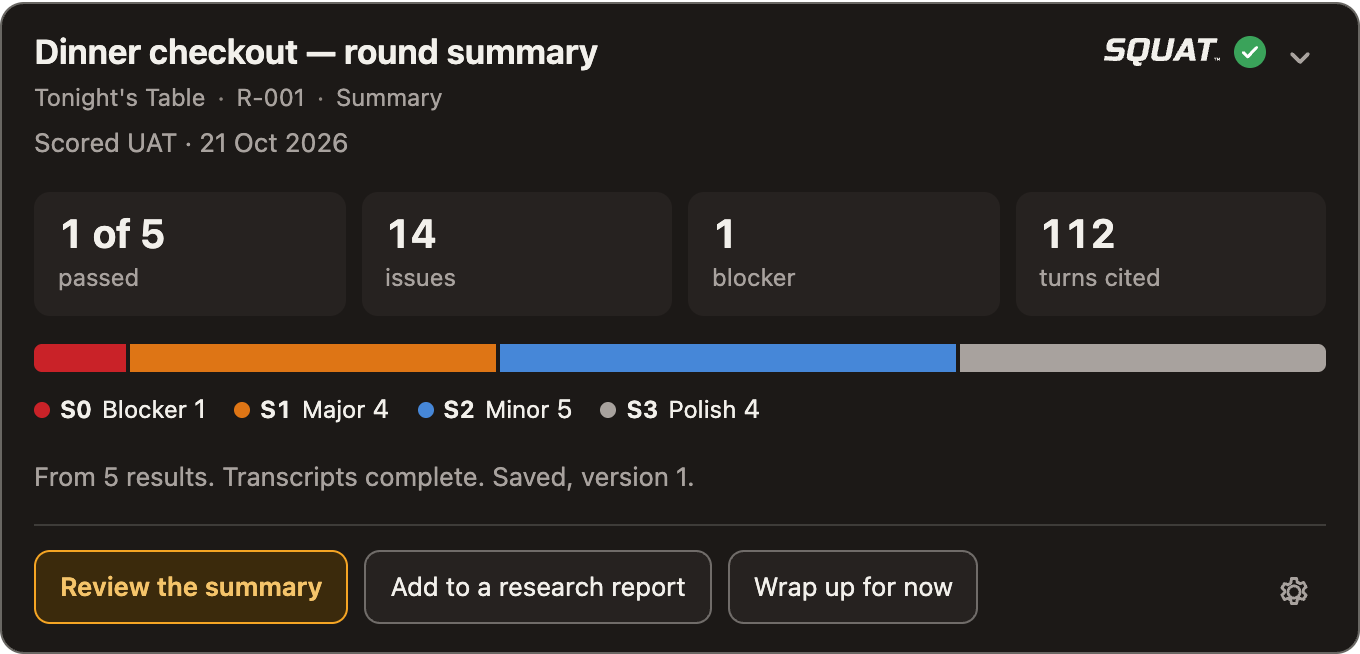
You give each squad a mission, complete with context and scenarios that you develop. They engage and SQUAT records the agent dialogue and provides a full report. Study findings can be directly traced back to that record — so when someone asks why you changed direction or you need to back up your recommendation, you've got the receipts.
SQUAT preserves a detailed ledger of the study: what was exposed, what was presented and in what order, how each persona responded, and the artifacts that were captured or used, like images and screen shots. That record makes it possible to learn over time and trace important assertions back to their source.
Where your squad comes from
You recruit the members of your squad - from interviews, existing persona profiles, or documented evidence.
Existing sources and documentation
Turn your pre-existing knowledge of customers, including their interests, beliefs, values, and behaviors into persona briefs.
Your direct knowledge and expertise
SQUAT can interview you (and others) and build a persona from your first-hand accounts.
Squad members are simulated research panelists. They present with personas, take on roles, respond to scenarios, and work to accomplish goals that you set. And they're not bashful about putting their impressions on the record.
Built for your way of working
Bring your own agent (BYOA)
SQUAT integrates directly with ChatGPT and Claude using the SQUAT Plug-In. Just create your SQUAT account, sign up for service, install the plug-in, and connect in minutes.
Works with the AI you already use
Your AI service handles inference and the interface between you and the SQUAT server. SQUAT supplies the service for your workspace, the methodology, and the ledger.
Durable methodology and record
AI can take a different path each time it tackles a problem. SQUAT guides each round through a consistent method and preserves the record so you can inspect the work and compare results over time.
Your IP and product knowledge stay yours.
Your IP is a valuable asset. That's why all product information, briefs, personas, reports, and other customer content entered into SQUAT are protected with service-managed application encryption: every workspace has its own unique key and it's wrapped by Google's Cloud KMS.
Questions builders ask first
Does SQUAT replace my existing scripted tests?
No. Keep your unit tests, integration tests, and harnesses — they help confirm the paths you created still run after a build, and they’re good at it. SQUAT is the experiential acceptance layer: whether a persona can accomplish a goal and survive the flow, not whether the flow executes.
How is a squad member different from a test script?
A script does what the code tells it to do. A squad member is a simulated tester working toward an objective. Give it a goal and no instructions and it will choose its own route through your product, including routes you never scripted. It is a simulation, not a person — so what it finds is a lead worth investigating and evidence worth keeping, not customer testimony.
Where do squad members come from?
We call this "recruitment" and there are two ways in. SQUAT can interview you about people or user archetypes you actually know — how they behave, what they want, and where they give up. Or you load research interviews and user profiles your team already maintains. These become personas in SQUAT, which you then assign to specific squads (teams).
Do I need to be an engineer or a "technical person" to use SQUAT?
No. You need to know what you are building and who it is for. SQUAT runs inside the agent tools you already use, and you work with it by talking to it — the same way you already work with Claude, ChatGPT/Codex, or LM Studio. Designers, strategists, agency principals, and product leads use it without writing code.
What does it cost to run a round?
SQUAT does not add a per-round or per-token charge. Rounds are unlimited on every paid tier and use the AI subscription you already pay for. Plan limits apply to workspaces, seats, devices, and add-on packs—not rounds. We may review excessive use and act on abuse to protect the system and other users.
Can I get my data out of SQUAT?
Any tier, any time. Your personas, records, and ledger are yours — request a workspace export and take them with you. The export profile lists exactly what is included and what is excluded, so you can check before you need it.
When will SQUAT be available?
SQUAT is in the final stages of development for its initial release — expected Fall 2026, opening first in the United States. Join the waitlist for progress updates and to be among the first users.
How do I organize a squad around the question I actually have?
Create a project for the work, assign the personas whose perspective the question needs, then describe the scenario and the goal. A SQUAT facilitator agent runs the round — a scored UAT round or a qualitative panel — and the results land in that project's ledger, so a later round has something to compare against.
More in Help.
Know before you go with SQUAT.™
SQUAT opens first in the United States in the fall of 2026. Join the waitlist and we'll tell you the moment you can start.
Join the waitlist